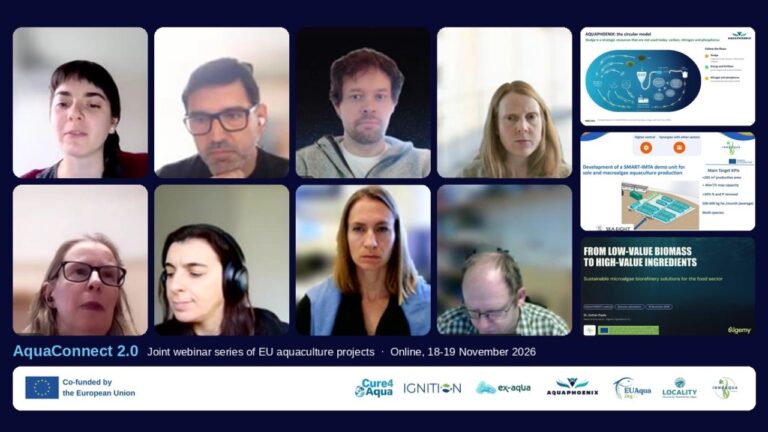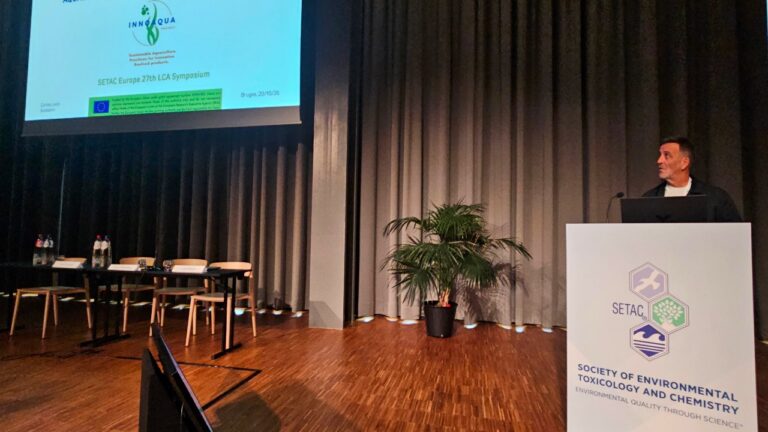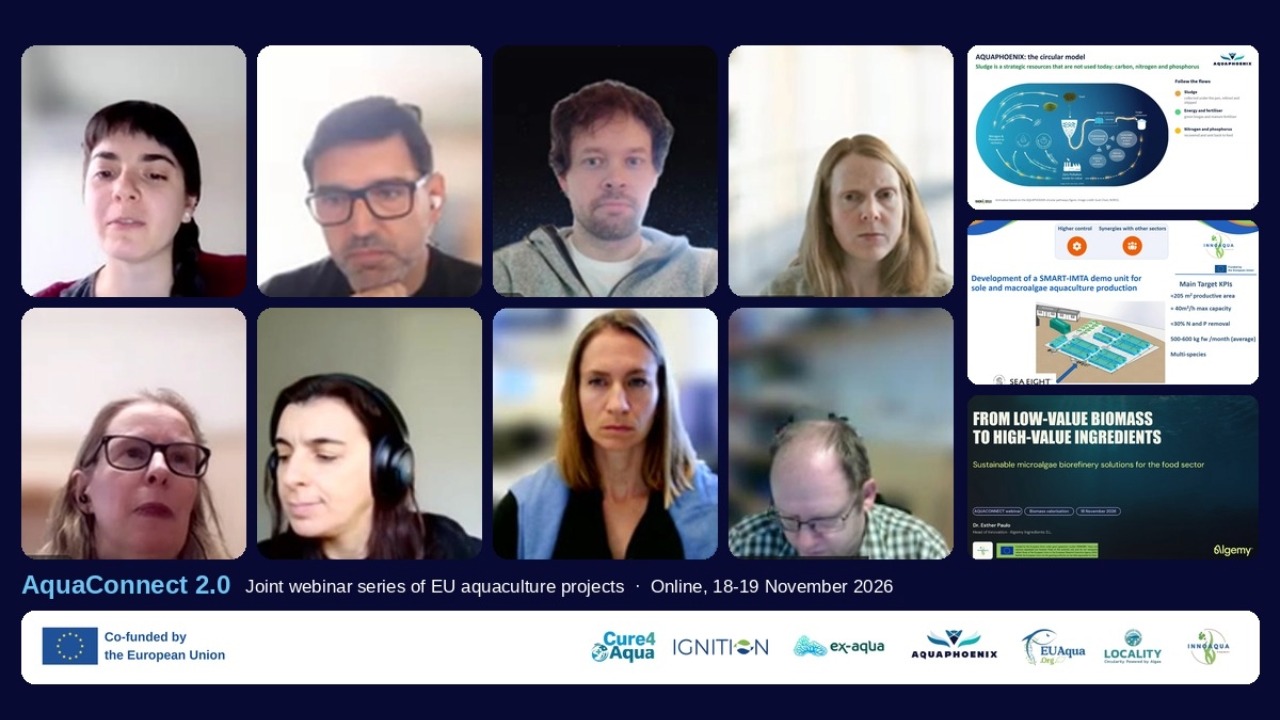
A year after its first edition, the AquaConnect cluster brought its projects back together online on 18 and 19 November 2026 for AquaConnect 2.0. Organised as two thematic sessions, one on biomass valorisation and one on animal production, the series gathered seven EU-funded projects (INNOAQUA, AQUAPHOENIX, LOCALITY, IGNITION, Cure4Aqua, EUAqua.Org and ex-aqua) to share solutions for a more circular and resilient aquaculture sector, in a programme designed around the needs of industry and open to academia.
On behalf of INNOAQUA, Kristína Duchoňová of PEDAL Consulting opened and moderated the first session, which was followed by nearly 80 participants and featured three INNOAQUA partners presenting their work.
INNOAQUA Contributions and Highlights
The first session, on 18 November, focused on what aquaculture biomass can become, and INNOAQUA’s three talks each followed a different raw material through that question.
Rui Pereira (A4F) presented seaweed biomass produced in land-based aquaculture, its applications and the challenges that still stand in the way of wider use. Laura Oleaga González (Pescanova Group) addressed fish side-streams as both an industrial challenge and an opportunity for innovation, from the point of view of a large seafood processor. Esther Paulo Mirasol (ALGEMY) showed how microalgae biorefinery can turn low-value biomass into high-value ingredients for the food sector.
Taken together, the three talks traced the route INNOAQUA works on, from fish and algae farmed together on land to ingredients and products for the food market, with each stream treated as a resource rather than a residue.
Cross-Project Insights
The other contributions to the first session came at the same theme from the farm side. Three AQUAPHOENIX partners from Norway and Sweden, RagnSells Havbruk, ST1Biokraft and EasyMining, presented routes for turning fish farm sludge into biogas, nutrients and other valuable resources. For LOCALITY, NIVA discussed industrial symbiosis between aquaculture and other sectors, and ALGEN reviewed the regulation and legislation that apply to algae.
The second session, on 19 November, moderated by Tânia Pereira and followed by around 50 participants, turned to the animals themselves. Speakers from Cure4Aqua, IGNITION and EUAqua.Org covered smart technologies for monitoring fish welfare in sea cages, vaccination strategies, non-invasive biomarkers for health monitoring, recirculating systems for marine fish breeders, genomic tools for clam breeding and a fish digital twin to support farm decisions.
One Value Chain, Many Projects
Across the two sessions, the programme covered the aquaculture chain from breeding, health and welfare to what is left once fish and algae are harvested. Most speakers in the biomass session came from companies that produce or process that biomass, which kept the discussion close to practical questions of scale, markets and regulation. For INNOAQUA, the series was a chance to present its results next to projects working on neighbouring links of the same chain.
Two editions in, AquaConnect has become a regular meeting point where results from separate EU projects can be read as parts of a single transition towards circular, sustainable aquaculture. INNOAQUA thanks the speakers, the partner projects and everyone who joined the two sessions and looks forward to continuing this exchange with its sister projects as it enters the final stage of its work.
Browse the materials from the first AquaConnect edition on Zenodo.