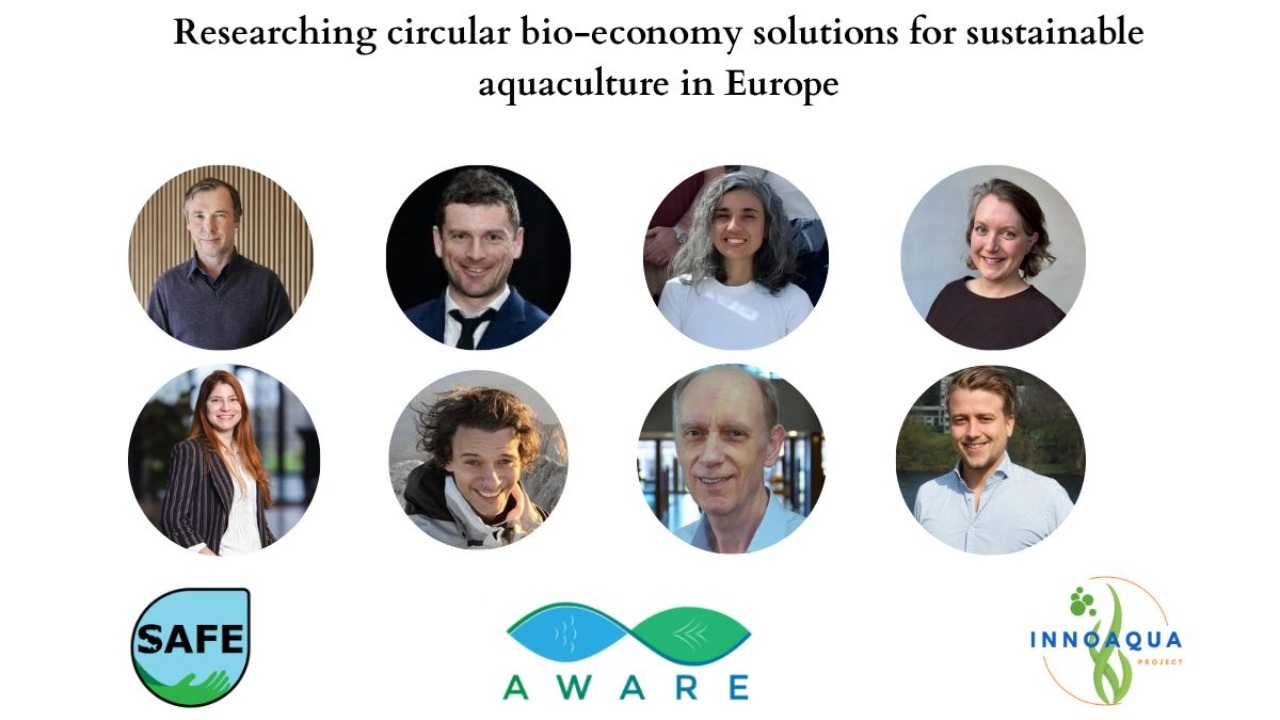
The SAFE–AWARE–INNOAQUA Summer School 2026 concluded on 26 June with its third and final session,“Sustainability and Acceptability”. Bringing together participants from across the aquaculture, research and innovation communities, the session explored the broader conditions needed for circular aquaculture solutions to be assessed, adopted and scaled across Europe.
Chaired by Richard Newton (University of Stirling, SAFE), the programme moved beyond technical innovations to examine the environmental, regulatory, financial and market factors that influence the uptake of circular aquaculture practices.
The session opened with Eoghan Clifford and Bernardete Rodrigues (University of Galway, SAFE), who discussed sustainability assessment in water and aquaculture systems, highlighting both the opportunities and challenges involved in measuring environmental and economic performance.
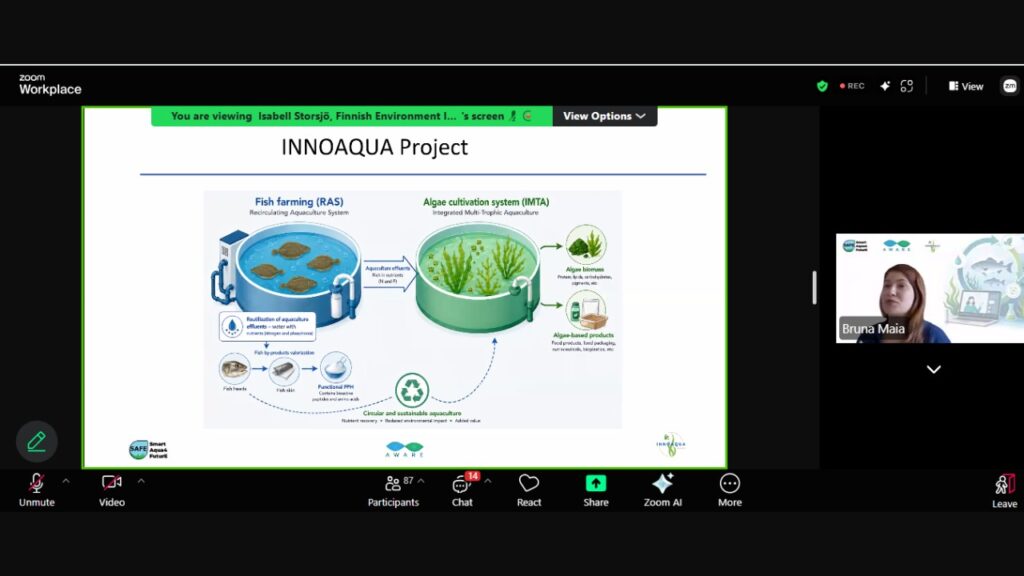
A strong INNOAQUA contribution came from Bruna Maia (3Bio, INNOAQUA), who joined Isabell Storsjö (SYKE, SAFE) to explore the current policy landscape for circular aquaculture in Europe. Their presentation examined the regulatory barriers and opportunities affecting resource recovery, circular production models and innovation uptake across the sector.
The programme also featured Fabio Ugolini (INNOVA SRL, AWARE), who introduced participants to patent landscaping through an aquaponics case study, while John Bostock (University of Stirling, SAFE) explored the financial and economic viability of circular bioeconomy innovations. The session concluded with Wesley Malcorps (University of Stirling, SAFE), who examined how circular approaches can contribute to stronger and more resilient European aquaculture value chains.
Throughout the discussions, a clear message emerged: technical innovation alone is not enough to deliver a circular aquaculture sector. Successful implementation also depends on supportive policies, viable business models, market acceptance and resilient value chains.
As the closing event of the SAFE–AWARE–INNOAQUA Summer School 2026, the session provided a fitting conclusion to a series that explored circular aquaculture from multiple perspectives, from resource recovery and innovative production systems to sustainability assessment, policy frameworks and economic viability.
For INNOAQUA, the Summer School represented an excellent opportunity to share knowledge, showcase project activities and engage with researchers, students and industry stakeholders committed to advancing sustainable aquaculture.
Missed the session?
If you were unable to attend live, you can still catch up on the presentations and discussions.
👉 Watch the Session 3 recording: